
15) Word Problems
Bonds of 5: Wholes to 5
Mathematics
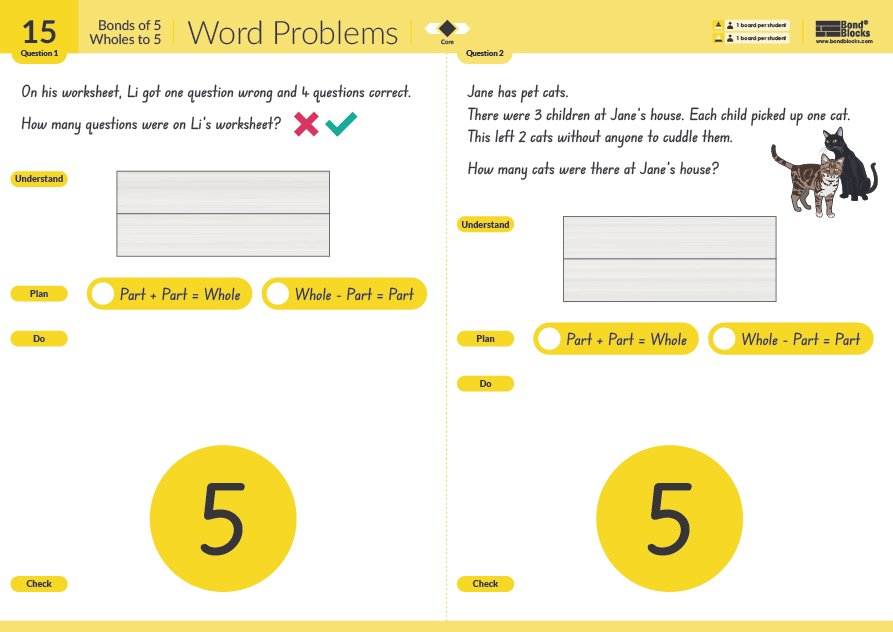
Apply the concept of part-part-whole and fluency recalling bonds, of wholes up to and including five, to solve addition and subtraction word problems.
Questions 1 to 6 are part-part-whole questions. The missing number is in a range of different positions. Students need to choose to use either addition or subtraction.
Language
Click this link to read Teacher Notes for more information about mathematical language related to “Solving Word Problems”. These notes outline the benefits of using a using a diagrammatic approach and caution against linking key words to specific operation.
Answers
Part-Part Whole Questions 1 to 6


Comparison Questions 7 to 12



Differentiation
A little easier
Concrete-Representational-Abstract: act it out
Assist students to understand the problem by instructing them them to act out of the situation before representing it with pictures and numbers. Students can act out the problem with:
- Actual objects (for example, toy cars) that feature in their problem.
- Objects such as blocks that represent the actual object. This is more difficult than using actual objects.
A little harder
Create a Question
Select one word problem. Use it as a model to change the word problem by:
- Changing the context of the parts and whole. For example, change the nouns from ‘fish’ (parts) in a ‘bowl’ (whole) to ‘cats’ in a ‘basket’.
and/or
- Changing the numbers. One way to do this is to use the same sized whole, but change the size of the parts. Alternatively, use a different sized whole.
Comparison Questions
Teach students to solve questions written using a comparision structure. This is different to a part-part-whole structure.
Questions 7 to 12 are comparison questions. The missing number is in a range of different positions. Students need to choose to use either addition or subtraction. Download activity boards from the top of the page.
Progression
The next chapter of activities focuses on initial double bonds that can be represented using the student’s two hands. The sequence of activities is similar to the Bonds of 5 chapter moving from identify bonds, to developing fluency, then calculating. Go to
Activity 16
Doubling and Halving to 10: Bonds, Building a Wall